FULFIL, recalculated
Triple therapy gave a lung-function gain patients can feel. The exacerbation and hospitalisation figures usually quoted from FULFIL are weaker than they sound.
Lipson et al., Am J Respir Crit Care Med 2017;196:438-46. Fluticasone furoate/umeclidinium/vilanterol 100/62.5/25 once daily (FF/UMEC/VI) vs budesonide/formoterol 400/12 twice daily (BUD/FOR).
FULFIL is the trial that compared single-inhaler triple therapy directly against the most familiar ICS/LABA in India, budesonide/formoterol. I recalculated its numbers the same way I did for IMPACT: absolute differences, NNTs, and how fragile each claim is.
The verdict first. Triple therapy improved lung function over ICS/LABA by a margin patients can feel. That result is real and robust. The exacerbation and hospitalisation figures usually quoted from FULFIL are weaker than they sound: they are secondary, unadjusted and built on few events. Part of the gap is also likely a LAMA-withdrawal effect in the BUD/FOR arm.
| Claim | Strength | Why |
|---|---|---|
| Triple improves trough FEV1 vs ICS/LABA | Proven | +171 mL (CI 148–194) at 24 weeks, +179 mL at 52 weeks. Above the 100 mL MCID. Co-primary, multiplicity-controlled. |
| Triple improves quality of life (SGRQ) | Statistically yes, clinically marginal | −2.2 units at 24 weeks, about half the 4-unit MCID. Not significant at 52 weeks (−2.7, p = 0.065). |
| Triple cuts exacerbations by 35% | Suggested, not proven | Secondary endpoint, no multiplicity correction. Low rates (0.22 vs 0.34 per year). Fragility index about 5 on patient counts. |
| 44% fewer exacerbations at 52 weeks | Weak | Only the 430-patient extension subset. CI runs from 15% to 63%. |
| Fewer hospitalisations | Not shown | 12 vs 22 patients. Not formally tested; crude Fisher p = 0.08. |
| Once-daily single inhaler improves adherence | Not tested | Double-dummy: every patient used both inhalers, once and twice daily. |
| Pneumonia higher with triple | Signal | 2.2% vs 0.8% at 24 weeks (crude p = 0.02). Not seen in the 52-week subset (1.9% vs 1.8%). |
| Mortality difference | None | 6 deaths in each arm. |
Design and population
FULFIL compared a triple inhaler against an ICS/LABA, not against LAMA/LABA or open triple. Most of its lung-function gain is therefore the LAMA being added. That framing drives the interpretation.
Strengths. The trial randomised 1,810 patients at about 200 centres. It was double-blind and double-dummy, with 24 weeks of treatment. The first 430 consenting patients continued to 52 weeks (the extension, EXT). The co-primary endpoints, trough FEV1 and SGRQ, were controlled for multiplicity with the Hochberg method.
Who was studied. Patients were 40 or older with a CAT score of 10 or more and on daily maintenance therapy for at least 3 months. They had FEV1 below 50%, or FEV1 50–80% with at least 2 moderate exacerbations or 1 severe one in the past year.
| Baseline feature | Value (triple / BUD/FOR) | What it means |
|---|---|---|
| Mean FEV1 | 45.5% / 45.1% predicted | Severe disease (GOLD 3) |
| Mean SGRQ total | 51.8 / 50.8 | High symptom burden |
| No exacerbation in the prior year | 34% / 35% | One in three were not exacerbators at all |
| At least 2 exacerbations in the prior year | 38% / 37% | Only a minority were frequent exacerbators |
| Current smokers | 44% / 44% | Higher than most COPD trials |
| History of pneumonia | 10% / 11% | Relevant to the pneumonia signal |
| Eosinophils, reversibility | Not reported | The eosinophil question cannot be answered from this paper |
The LAMA-withdrawal problem
Patients stayed on their own medication through a 2-week run-in. At randomisation they switched abruptly, with no washout. This is the mirror image of the ICS-withdrawal problem in IMPACT.
| Prior therapy at screening | Share (approx.) | If randomised to BUD/FOR | If randomised to triple |
|---|---|---|---|
| Triple (ICS + LAMA + LABA) | 28% | Lost LAMA | No change |
| ICS/LABA | 29% | No change | Gained LAMA |
| LAMA/LABA | about 10% | Lost LAMA, gained ICS | Gained ICS |
| LAMA alone | about 8% | Lost LAMA, gained ICS + LABA | Gained ICS + LABA |
| Other | about 25% | Varies | Varies |
My calculation: about 45% of the BUD/FOR arm (28% + 10% + 8%) had a LAMA stopped on day one. In the triple arm, nobody lost a drug class.
The FEV1 data fit this. BUD/FOR patients fell 29 mL from baseline by week 24 and 53 mL by week 52, while triple rose 142 mL. Part of the 171 mL gap is the loss of a bronchodilator, not only the gain of one.
Re-calculated efficacy
Lung function is FULFIL’s strongest result: about 3 patients must be switched to triple for one extra FEV1 responder. Quality of life is real but small, at about 12 patients per extra responder.
| Outcome (week 24, ITT) | Triple | BUD/FOR | Absolute difference | NNT |
|---|---|---|---|---|
| FEV1 responders, ≥100 mL gain | 50% (453/911) | 20% (184/899) | 29 points | 3.4 |
| SGRQ responders, ≥4-unit fall | 49% (448/911) | 41% (368/899) | 8 points | 12 |
| SGRQ responders at week 52 (EXT) | 44% | 33% | 11 points | 9 |
Effect size compared with what patients can feel
| Outcome | Week 24 | Week 52 (EXT) | MCID | Verdict |
|---|---|---|---|---|
| Trough FEV1 | +171 mL (148–194) | +179 mL (131–226) | about 100 mL | Clearly above MCID, sustained |
| SGRQ total | −2.2 (−3.5 to −1.0) | −2.7 (−5.5 to 0.2), NS | 4 points | About half the MCID |
The mean SGRQ change is below what patients notice, so the responder analysis is the fairer clinical lens. About 1 in 12 extra patients gains a meaningful quality-of-life improvement on triple.
The FEV1 gain is larger than the authors expected. They powered for 80 mL and could not explain why benefits looked larger than in TRILOGY. The LAMA withdrawal in the BUD/FOR arm is one plausible reason.
Exacerbations and the 52-week extension
Moderate or severe exacerbations were 35% lower on triple at 24 weeks (rate ratio 0.65, CI 0.49–0.86). The direction is credible; the size is not settled.
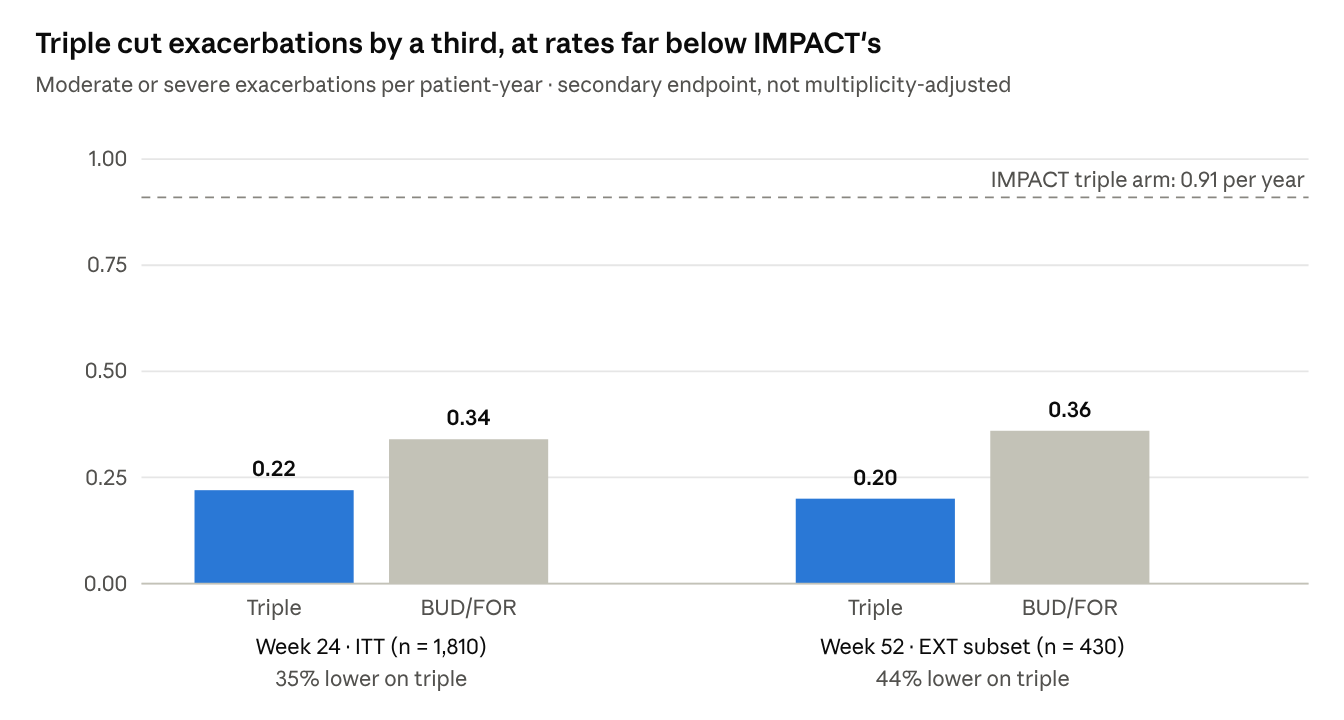
Source: Lipson et al., AJRCCM 2017 (FULFIL); IMPACT reference from Lipson et al., NEJM 2018.
Absolute terms. The rate gap at 24 weeks is 0.12 per year, about 8 patient-years per exacerbation avoided. Counted per patient, 10.4% vs 14.0% had an exacerbation in 24 weeks: an NNT of about 28.
The 44% figure. It comes from the 430-patient extension subset (rate ratio 0.56, CI 0.37–0.85). The gap there is 0.16 per year, about 6 patient-years per event avoided. It is consistent with the 24-week result but adds little precision.
Hospitalisations. 12 (1.3%) vs 22 (2.4%) patients were hospitalised for an exacerbation. That was not formally tested; a crude Fisher test gives p = 0.08.
Benefit vs harm
Over 24 weeks, triple prevents about 4 moderate or severe exacerbations for every extra pneumonia. On serious events the trade is close to even, so patient selection matters more here than the headline suggests.
Per 1,000 patients treated for 24 weeks with triple instead of BUD/FOR (my calculation from the paper’s rates):
| Measure | Triple | BUD/FOR | Difference per 1,000 |
|---|---|---|---|
| Moderate or severe exacerbations (annual rates 0.22 vs 0.34) | about 102 | about 157 | 55 fewer |
| Patients with ≥1 moderate or severe exacerbation | 104 | 140 | 36 fewer |
| Patients hospitalised for an exacerbation | 13 | 24 | 11 fewer (NS) |
| Patients with pneumonia (AESI) | 22 | 8 | 14 more |
Pneumonia, counted per patient. 20 of 911 (2.2%) on triple vs 7 of 899 (0.8%) on BUD/FOR. That is +1.4 points, an NNH of about 70 over 24 weeks. A crude Fisher test gives p = 0.02, but moving 3 cases makes it non-significant.
A pneumonia is usually worse than a moderate exacerbation. The fairer comparison is about 11 hospitalisations avoided against 14 extra pneumonias, not all of them serious. Both arms contained an ICS, so the excess is likely the fluticasone furoate molecule or its dose, not ICS as a class. In the 52-week subset the rates were equal (1.9% vs 1.8%), but with only about 4 cases per arm.
Statistical red flags
The co-primary analysis is clean. Five patterns tell a careful reader not to lean on the secondary claims.
- Exacerbations were not what the trial was built for. FULFIL was powered for an 80 mL FEV1 difference and a 2.5-unit SGRQ difference. Exacerbations were secondary, and the paper states that secondary outcomes were not adjusted for multiplicity. The authors themselves say few patients exacerbated, so these findings are less robust.
- Few events, low-risk population. Event rates were 0.22 and 0.34 per year, about a quarter of IMPACT’s. Only 95 and 126 patients had an exacerbation. One in three had none in the prior year. Shift 5 patients and the patient-level difference loses significance.
- The 52-week numbers come from a self-selected subset. EXT was the first 430 patients who consented to continue. Randomisation holds within it, but it is a quarter of the trial and too small for exacerbations (CI 15–63%) or SGRQ (NS).
- Different molecules, devices and dosing. The comparator differed in ICS, LABA, device (Turbuhaler vs Ellipta) and frequency. Double-dummy blinding means everyone used two inhalers, so FULFIL cannot show any adherence or convenience benefit from one inhaler once a day.
- Abrupt LAMA withdrawal. About 45% of the BUD/FOR arm lost a LAMA at randomisation. BUD/FOR FEV1 fell below baseline, and “COPD worsening” adverse events at 52 weeks were 10% vs 2%. Both fit a step-down effect inflating every between-arm gap.
Also note. The trial was sponsored, designed and analysed with GSK, maker of the product, and several authors were GSK employees. Eosinophil and reversibility data were not reported in the primary paper, so any eosinophil-based claim needs a separate source.
What FULFIL actually tells us
In symptomatic, severe COPD patients on ICS/LABA, adding the LAMA as once-daily FF/UMEC/VI gives a large, lasting lung-function gain of about 170 mL. Quality of life improves modestly, and exacerbations probably fall. The cost is a small pneumonia excess, about 1 extra case per 70 patients over 24 weeks.
Who should get triple, according to this evidence
- On ICS/LABA and still breathless (CAT ≥10). This is exactly the FULFIL population: NNT 3.4 for a meaningful FEV1 gain.
- On ICS/LABA and exacerbating. The direction favours triple, but rely on IMPACT for the size of the effect, not FULFIL.
- Already on triple and stable. Do not drop the LAMA. The BUD/FOR arm’s falling FEV1 shows what step-down does.
- Past pneumonia or low infection resilience. Weigh the 2.2% vs 0.8% signal before switching.
Honest claims, and claims to avoid
| Fair to say | Avoid |
|---|---|
| “In FULFIL, FF/UMEC/VI improved trough FEV1 by 171 mL vs BUD/FOR at 24 weeks, sustained at 52 weeks.” | “Twice the bronchodilation”, or any FEV1 claim vs LAMA/LABA (not tested). |
| “Half of patients on triple gained ≥100 mL FEV1, vs 1 in 5 on BUD/FOR.” | “Improves quality of life” without the responder rate (49% vs 41%). |
| “Moderate or severe exacerbations were 35% lower (secondary endpoint).” | “Proven 35% reduction in exacerbations”, or quoting the 44% subset figure alone. |
| “Once-daily single-inhaler triple therapy.” | “Better adherence than twice-daily therapy” (both arms used two inhalers). |
| “Pneumonia was more frequent with triple at 24 weeks; select patients accordingly.” | “Fewer hospitalisations”, or any mortality claim (not shown). |
Disclosure: my company, Bayu Healthcare, markets respiratory inhalers, including triple therapy. FULFIL used GSK’s Ellipta product; I discuss it here as evidence for the molecule combination, and I wrote this appraisal partly to keep our own claims honest.